Borofluoric Acid as a Catalyst in the Formation of Borofluoride Salts
2025-01-08
Borofluoric acid (HBF4) is a highly reactive inorganic acid widely used in various chemical and industrial applications. One of its most significant roles is as
a catalyst in reactions that produce borofluoride salts (BF4-) or in catalyzing specific chemical transformations. This detailed article explores the conditions
under which borofluoric acid functions as a catalyst, its mechanisms of action, and its various industrial applications.

1、What are Borofluoride Salts?
1.1 Definition and Composition
Borofluoride salts are chemical compounds containing the tetrafluoroborate anion (BF4-). These salts are typically formed by reacting borofluoric acid with a base.
The resulting salts are highly stable and exhibit unique properties that make them useful in numerous industries. Examples include:
● Sodium tetrafluoroborate (NaBF₄): Used in electroplating and metal finishing.
● Potassium tetrafluoroborate (KBF₄): Commonly employed in aluminum welding and brazing.
● Ammonium tetrafluoroborate (NH₄BF₄): Utilized in specialty organic synthesis.
1.2 Properties of BF4- Salts
● Stability: The BF4- anion is highly resistant to hydrolysis, even under acidic conditions.
● Solubility: These salts are soluble in polar solvents such as water and alcohols.
● Non-reactivity: BF4- salts are chemically inert in many reaction conditions, making them excellent supporting agents.
2、Conditions for Borofluoric Acid to Act as a Catalyst
2.1 Acid-Base Neutralization
In reactions where borofluoride salts are formed, borofluoric acid dissociates to release BF4- ions. The presence of a suitable base, such as alkali or alkaline
earth metals, is necessary to neutralize the acidic environment and produce the desired salt. For example:

This reaction is commonly performed in aqueous solutions, with strict control over pH to avoid hydrolysis.
2.2 Role as a Strong Lewis Acid
Borofluoric acid acts as a Lewis acid, meaning it can accept electron pairs from nucleophiles. This property is critical in catalyzing reactions such as
Friedel-Crafts alkylation and acylation. The strong acidity of HBF₄ enhances its ability to activate electrophiles, facilitating their reaction with aromatic compounds.
3、Mechanisms of Catalysis by Borofluoric Acid
3.1 Proton Donation in Organic Reactions
Borofluoric acid, as a Brønsted acid, donates protons to substrates, thereby increasing their reactivity. For example:

In this case, alcohols are protonated to form oxonium ions, which are more electrophilic and readily undergo substitution or elimination reactions.
3.2 Complex Formation in Metal-Catalyzed Reactions
Borofluoric acid can stabilize transition states by forming complexes with metal ions. For instance, in organometallic reactions, HBF4 can bind to catalytic centers,
reducing the energy barrier for bond formation or cleavage.
3.3 Ionic Pairing and Solubilization
The BF4- ion is a stable counterion that can facilitate the dissolution of reaction intermediates. This property is particularly valuable in biphasic reactions,
where HBF₄ helps transfer reactive species between aqueous and organic phases.
4、Specific Applications of HBF₄ as a Catalyst
4.1 Organic Synthesis
In organic chemistry, HBF₄ is a versatile catalyst for several key reactions:
● Hydroamination:
Borofluoric acid facilitates the addition of amines to alkenes or alkynes, yielding valuable amine derivatives used in pharmaceuticals and materials science.
● Esterification and Transesterification:
The strong acidity of HBF₄ promotes the formation of esters by reacting alcohols with carboxylic acids or their derivatives.
● Friedel-Crafts Reactions:
By activating aromatic compounds and electrophiles, HBF₄ enables the alkylation and acylation of benzene rings, producing intermediates for dyes, perfumes, and plastics.
4.2 Electrochemistry
Borofluoric acid plays a dual role as an electrolyte and catalyst in electrochemical applications:
● Metal Electrodeposition:
In processes like copper or tin plating, HBF₄ stabilizes metal ions in solution, ensuring uniform deposition on substrates.
● Battery Technology:
Borofluoride salts derived from HBF₄ are increasingly used in lithium-ion batteries, where they enhance electrolyte conductivity and thermal stability.
4.3 Polymerization
HBF4 catalyzes the polymerization of monomers, such as styrene, to produce industrially important polymers like polystyrene. The acid acts by activating double
bonds in monomers, initiating chain reactions that lead to polymer formation:

4.4 Pharmaceuticals
In the pharmaceutical industry, borofluoric acid is used to synthesize drug precursors and intermediates. For example:
● Peptide Synthesis:
HBF4 catalyzes the formation of peptide bonds by activating carboxylic acids or amines.
● Fluorination Reactions:
The acid facilitates the incorporation of fluorine atoms into organic molecules, a common modification in drug design.
5、Benefits and Challenges of Using HBF4
5.1 Benefits
● High Reactivity: Enables faster and more efficient chemical transformations.
● Selectivity: Ensures specific activation of target substrates.
● Adaptability: Functions in a variety of solvents and reaction conditions.
5.2 Challenges
● Corrosiveness: Requires corrosion-resistant equipment and careful handling.
● Environmental Concerns: Waste containing HBF₄ must be neutralized to prevent ecological damage.
● Cost: The production and storage of borofluoric acid can be expensive, limiting its use in large-scale processes.
6、Environmental and Safety Considerations
The safe handling and disposal of HBF₄ are critical due to its corrosive nature. Proper measures include:
● Neutralization of Effluents: Using bases to neutralize acidic waste.
● Use of Protective Equipment: Ensuring the safety of personnel handling the acid.
● Recycling: Developing technologies to recover and reuse borofluoric acid in industrial processes.
Borofluoric acid is a versatile catalyst that plays an essential role in the synthesis of borofluoride salts and the catalysis of diverse chemical reactions.
Its strong acidity, ability to stabilize reactive intermediates, and adaptability to various industrial applications underscore its importance in modern chemistry.
While challenges such as corrosiveness and environmental impact remain, advancements in safety protocols and recycling technologies are paving the way
for its broader adoption.
The Application and Optimization of Fluorosilicic Acid in Aluminum Electrolysis Production
The Application of Hexafluorosilicic Acid as a Wet Etching Agent in the Electronics Industry
Related Article
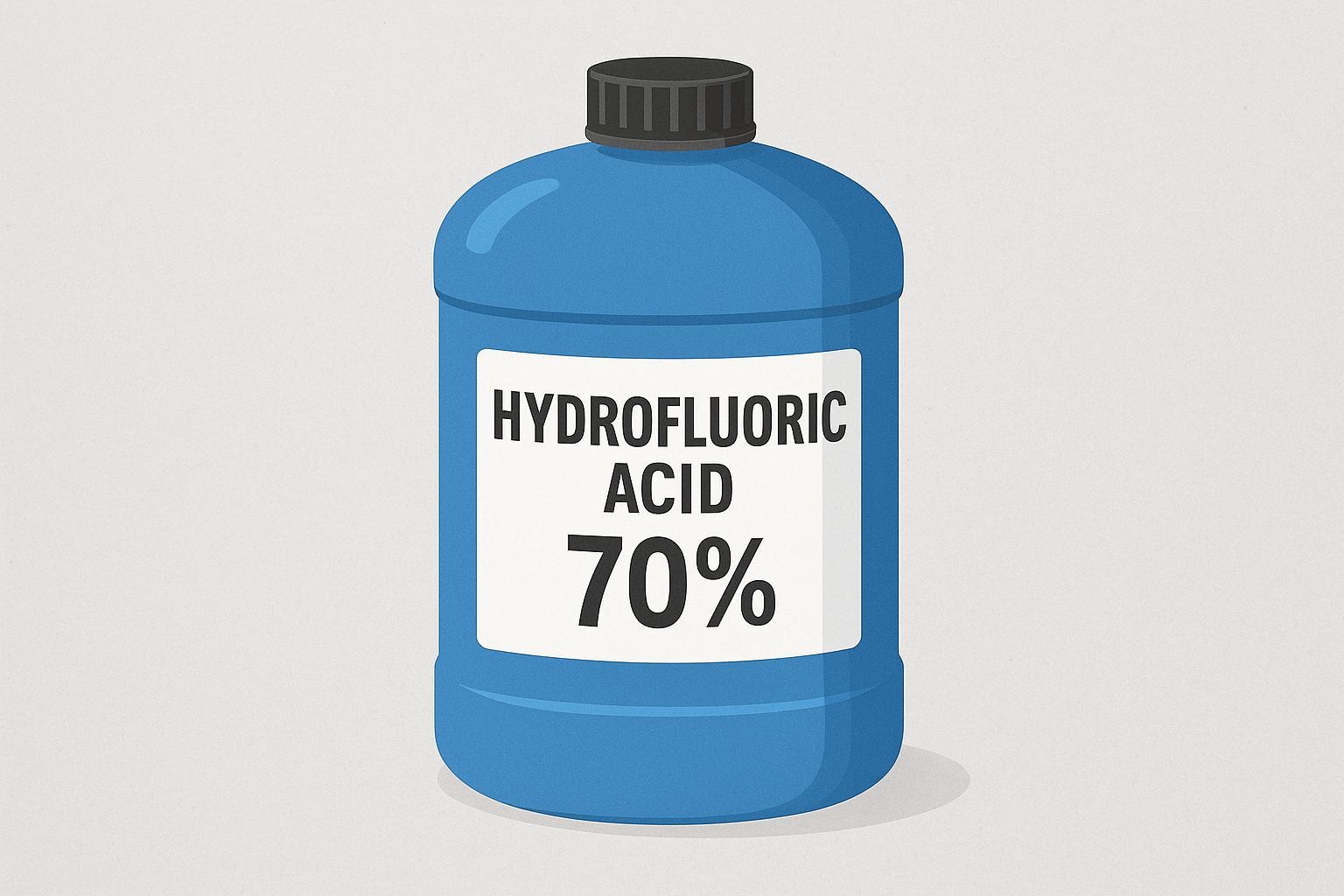
Discover why 70% hydrofluoric acid is preferred globally — balancing reactivity, safety, and cost-efficiency for glass, metal, and semiconductor industries.
Why International Buyers Prefer Purchasing Hydrofluoric Acid with 70% Concentration

FSSF Chemical leads you to discover the industrial uses of fluoroboric acid (HBF₄), including applications in electroplating, metal cleaning, catalysis, pharmaceuticals, and battery technology.
The Comprehensive Industrial Applications of Fluoroboric Acid (HBF4)